Innovating Costly Processes
internal process
external process
process innovation
customization
notifications/alerts
operations
collaboration
In an internal innovation challenge reminiscent of the TV show "Shark Tank," our team tackled how to enhance our custody and clearing platform by empowering financial advisor clients to customize their own notifications. The project made it to the Top 4 selections and won $15,000.
Who are the users? What are their goals?
The Wealthscape platform for Fidelity Institutional enables financial professionals to manage their book of business with functions such as trading investments, opening accounts, or generating reports to identify client trends. These activities generate email alerts that the advisor can use to track work and processes when they are away from the platform.
Auto-generated alerts: Alerts sent by the system for generic processes such as opening new accounts or completing trades. These emails are redundant because advisors are in the system daily.
User-subscribed alerts: Users can opt into alerts for specific accounts or actions in the system, however the information provided is generic so that the alert template can be reused for multiple activities. Users have to click through the notification into the system to get the full context of the alert.
A major benefit of using the Wealthscape platform is that it can be customized to support the specific internal policies of individual financial investment firms. Firms can request that new alerts be created to complement their specific internal processes. Each requested alert is created manually by developers and goes through a review process to ensure that it meets the requirements of both the investment firm and Fidelity. To recoup the expenditure of creating the new alert, the Wealthscape notification product publishes that new alert to all firms to drive higher utility.
Feedback and metrics showed that the alerts provided to users of Wealthscape were performing at a high cost and a low utility.
2%
open rate for auto-generated alerts
False Positive Clickthrough Rate
for user-subscribed alerts
6 months
typical build time for new alerts
Problem Statements
Wealthscape users are getting too many useless alerts emailed to them. Even for desired alerts, the information provided is too generic to be valuable. Users have to click through the email and login to decide if they need to reprioritize ongoing work.
It takes too long to create new alerts because they are being built individually. Clients are dissatisfied with Fidelity’s speed of service when the alert need isn’t met for 6 months.
How might we ensure that the alerts are relevant and useful?
How might we make creating alerts more cost-effective?
Solution Approach
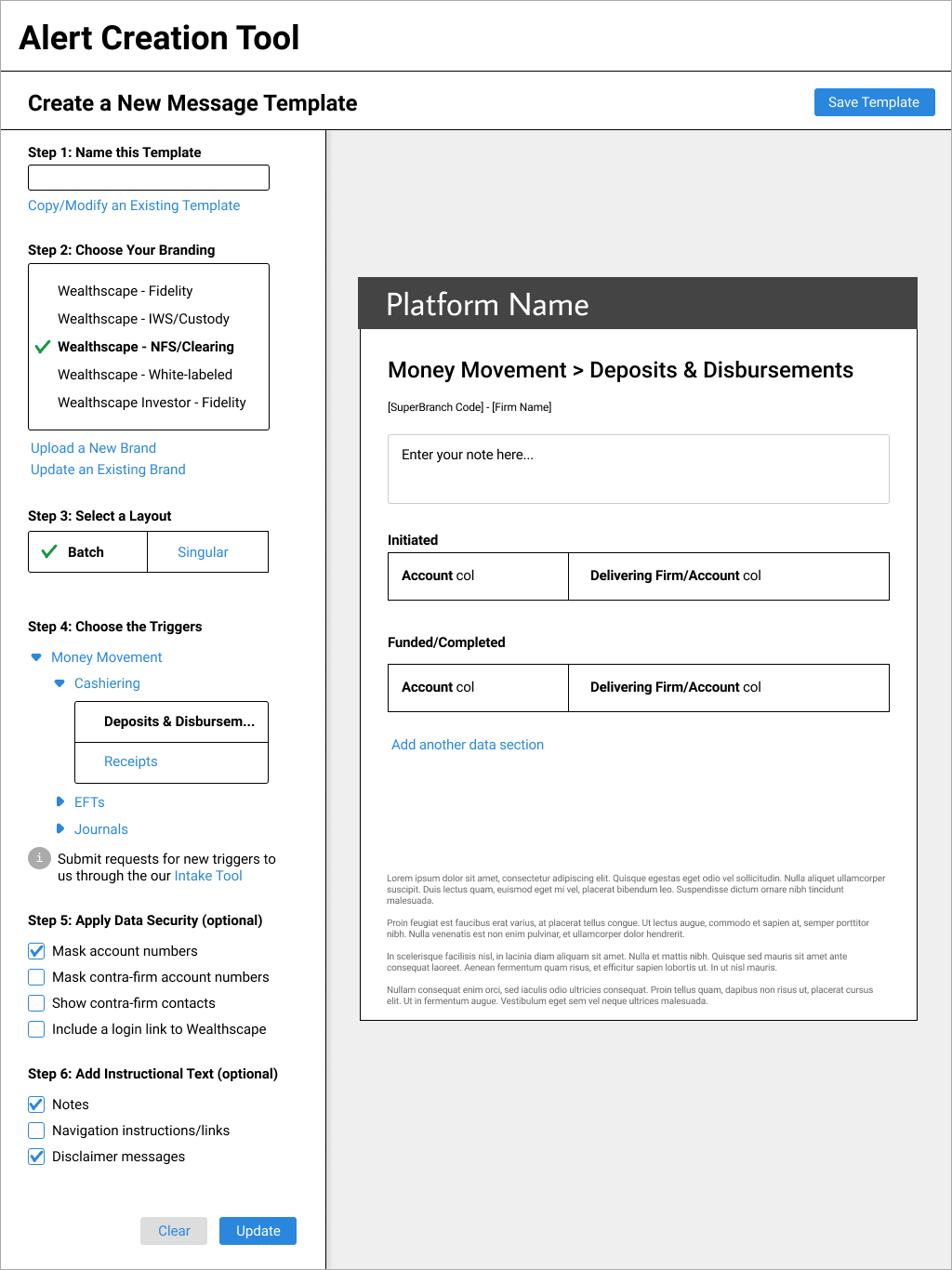
We wanted to create a self-service tool for financial advisors to customize alerts to their needs. The customization could apply at the user or firm level and allows users to include the information that they consider relevant including firm-specific information.
Target Goals & Metrics:
Define a process and architecture where alerts can be authored and published by users for their own use
Self-authored alerts should still meet the compliance, regulatory, and risk management policies of Fidelity and the user’s firm
Taking stock of what we had
My team consisted of a Product Owner, Systems Architect, and myself as a UX Designer. We wanted to create a self-service tool for financial advisors to customize alerts to their needs. The tool would provide layout templates and a data library to the advisors so that they could create the alerts they found most valuable. The templates would be approved by the compliance teams of the advisory firm to ensure business practice alignment.
I mapped the current alerts into UI templates and the Systems Architect reviewed the backend to catalogue all of the data fields that were currently enabled. The Product Owner reviewed the past few years of requests to find trends in requests from firms. As a team, we gathered additional experience and process requirements from the other groups that typically involved in meeting these client requests for alerts such as relationship managers, lawyers, risk reviewers, and brand management.
Firm-Level Requirements
Allow brand and sub-brand identification, including adding logos, team names, and direct line phone numbers into alerts
Deep links in the email to the issue resolution UIs within Wealthscape
Customized legal disclaimer language for end investor-facing notifications
Fidelity Requirements
Do not take on any liability for user-created communications
Enforce permissions that are present in the rest of the platform for investor privacy
Enforce data retention policies that are present in the rest of the platform
Product Requirements
Enable developers to create new alerts templates that can be pushed to firms for customization
Provide guidance to authors on email communication techniques
Limit utility to just notifications. Do not recreate the entire system in an email
Flushing out the concept
To make our proposal, the Solutions Architect explored how we could create an external-facing data library service and UI for clients to use based on our current alerting engine.
Thinking about the type of information that we wanted to customize in the tool, it became apparent that our tool would need a content management system (CMS). Since the requests weren’t just for platform event data, but brand- or business-specificity that would be used across any alerts belonging to the same client, we wanted to store suggested content and logos. The CMS would then enable the compliance staff at the investment firms to have some oversight and maintain an approval process for publishing new content into the data library. We then explored how individual users would request new templates and triggering events for alerts to keep the tool as self-service as possible.
For the user’s experience, these functionalities created the need for multiple roles to run the system:
Firm Administrator - someone with authority at the investment firm to provide official versions of branding, privacy and compliance policies, and approve of the authored alerts
Authors - users within the investment firm who were permissioned to create alerts with the elements provided by the Firm Administrator. These users would need to know enough to create accurate and useful alerts.
Recipients - users who only could subscribe to and receive alerts.
Operationalizing a new tool
The proof of concept successfully showed how we could expose the alerting system to the financial advisors in a secure way and connect to a CMS.
In the authorship process, the language in the alerts would need to be reviewed to make sure they are not accidentally misleading or inappropriate when they are populated. This means that the legal and risk group for either Wealthscape or the clients’ compliance teams would need to be involved in the template approval process. It became clear that neither the platform’s legal and risk team nor the clients’ compliance teams were staffed appropriately to review the anticipated volume of alert templates that the tool would create.
Since the alerts would still live on the platform and be issued from the platform, Wealthscape ultimately still had some liability in who consumed the alerts and what those alerts said.
Outcomes of the challenge
Although the Alert Creation Tool was hampered operationally, the insights we uncovered around brand customization and templating were translated into backlog items for notification product.
Goals & Metrics Outcome
$10,000 estimated savings in development costs for each new alert
20% estimated decrease in the cost to run the alerts product
$15,000 prize for the challenge idea